

A hotel IPTV network can have enough bandwidth on paper and still develop problems at peak occupancy.
The reason is simple: not every part of the network carries the same traffic.
A guest-room TV, a floor uplink, and the core backbone have very different jobs. Using the same bandwidth everywhere can waste budget, while under-sizing an aggregation point can create a bottleneck.
So where should you use 1G, 10G and 25G?
Match Bandwidth to the Traffic Path
For hospitality IPTV, think about the traffic path first:
Guest Room → Floor Switch → Uplink → Core
Match bandwidth to each layer:
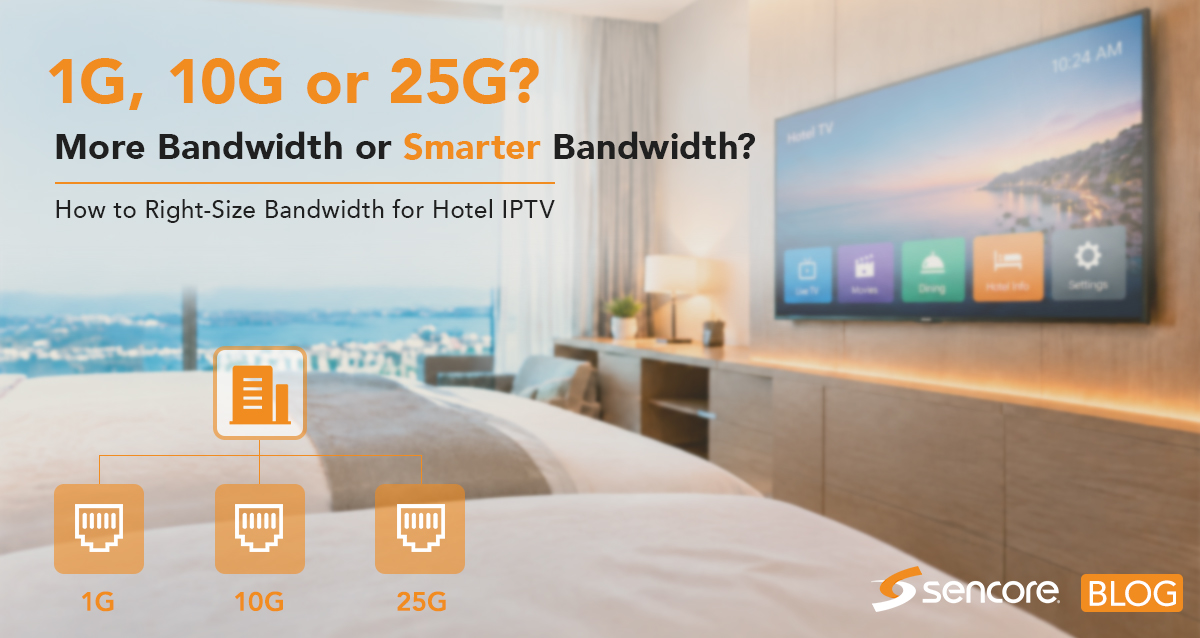
- 1G:Room-level TV/STB connections
- 10G:Floor-switch uplinks
- 25G:Core backbone for large properties
The key is not to put 25G everywhere.
It is to put higher capacity where traffic starts to accumulate.
Don’t Calculate Bandwidth as Rooms × Channels
Consider a 500-room hotel carrying 50 live channels at an average of 6 Mbps per channel.
That does not mean the network needs:
500 × 50 × 6 Mbps
That calculation assumes every room is simultaneously receiving every channel.
In a multicast IPTV network, viewers request individual channels, while IGMP Snooping helps ensure multicast streams are forwarded only where they are needed. The actual traffic on a link depends on the streams crossing that particular part of the network.
For example:
50 channels × 6 Mbps = 300 Mbps
That represents the combined bitrate of 50 distinct streams if they all cross the same network segment. It is not automatically the bandwidth requirement of every link in the hotel.
This distinction matters when deciding whether an uplink or core needs more capacity.
Where Does 25G Make Sense?
For a smaller property, 10G may provide sufficient aggregation capacity.
As properties become larger, more floor traffic converges at the core. That is where 25G becomes useful.
For larger properties, 25G can provide additional capacity at the core as more floor traffic converges. It is not necessary for every network connection.
So, the practical decision is:
- Room:Is 1G sufficient? Usually yes.
- Floor:Is 10G enough for aggregated traffic?
- Core:Does the property justify 25G?
- Uplinks:Is LACP needed for resilience?
The Takeaway
Hotel IPTV does not need the fastest interface everywhere.
Use 1G for the room, 10G where floor traffic aggregates, and 25G at the core when the property size and traffic justify it.
The goal is not to buy more bandwidth.
It is to put the right bandwidth in the right place.