


A hotel, hospital, or cruise ship can have enough IPTV bandwidth and still have one weak point: a single uplink. If a floor access switch connects to the core through one 10G link, that link becomes a single physical dependency. If it fails, the IPTV endpoints behind that switch can lose connectivity.
For mission-critical IPTV, the question is not only “Is the uplink fast enough?” It is also:
“What happens if this one physical link fails?”
This is where LACP link bonding can add both aggregate capacity and link-level redundancy.
One Uplink Means One Physical Dependency
A 10G uplink may provide sufficient bandwidth, but if it is the only connection between the access switch and core, a physical link failure can interrupt connectivity.
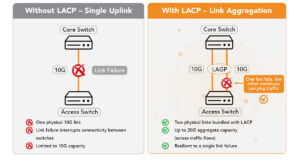
Instead of: Access Switch → 10G → Core
the design can use: Access Switch → 10G + 10G → Core
With LACP, multiple physical Ethernet links are combined into one logical connection.
Without link bonding
- One physical uplink
- One link failure can disconnect the access switch
- Capacity is limited to that single link
With LACP
- Multiple physical links form one logical connection
- Aggregate capacity increases across the link group
- The remaining link can continue carrying traffic if one member fails
What Does LACP Actually Add?
LACP combines multiple physical links into one logical connection. Traffic can be distributed across the member links, while a failed member link can be removed from the bundle so the remaining link(s) can continue carrying traffic.
For IPTV, the important point is that the physical links remain 10G links. The practical benefit is that the access switch has another physical link available if one connection fails.
When Is LACP Worth Considering?
LACP becomes more relevant when:
- The uplink serves many IPTV endpoints
- IPTV is an important guest, patient, or passenger service
- Losing the uplink would interrupt service to those endpoints
- Additional aggregate uplink capacity is useful
- The access and core switches support compatible LACP configurations
For mission-critical sites, LACP can also be used as part of a broader redundant network design. LACP itself does not make the entire network redundant.
The Practical Decision
Before adding LACP, ask:
“What is the impact if this single uplink fails?”
If one failed link can disconnect a critical group of IPTV endpoints, link bonding may be worth considering.
LACP addresses a specific network risk: dependence on one physical uplink. It can also provide additional aggregate capacity where the traffic profile requires it.
For mission-critical IPTV, that can make the uplink more resilient without replacing the entire network.